
Statistical Models
Lecture 1
Lecture 1:
An introduction to Statistics
Outline of Lecture 1
- Module info
- Introduction
- Probability revision I
- Moment generating functions
- Probability revision II
- Probability revision III
Part 1:
Module info
Contact details
- Lecturer: Dr. Silvio Fanzon
- Email: S.Fanzon@hull.ac.uk
- Office: Room 311C, Robert Blackburn Building
- Office hours: Monday 12:00-13:00
- Meetings: in my office or send me an Email
Questions
If you have any questions please feel free to
email meWe will address
HomeworkandCourseworkin classIn addition, please do not hesitate to attend
office hours
Lectures
Each week we have
- 2 Lectures of 2h each
- 1 Tutorial of 1h
| Session | Date | Place |
|---|---|---|
| Lecture 1 | Mon 16:00-18:00 | Wilberforce LR 16 |
| Lecture 2 | Thu 16:00-18:00 | Wilberforce LR 16 |
| Tutorial | Tue 12:00-13:00 | Wilberforce LR 21 |
Assessment
This module will be assessed as follows:
| Type of Assessment | Percentage of final grade |
|---|---|
| Coursework Portfolio | 70% |
| Homework | 30% |
Rules for Coursework
Coursework available on Canvas from Week 9
Coursework must be submitted on Canvas
Deadline: 14:00 on Thursday 30th April
No Late Submission allowed
Rules for Homework
How to submit assignments
Submit PDFs only on Canvas
You have two options:
- Write on tablet and submit PDF Output
- Write on paper and Scan in Black and White using a Scanner or Scanner App (Tiny Scanner, Scanner Pro, …)
Important: I will not mark
- Assignments submitted outside of Canvas
- Assignments submitted more than 24h After the Deadline
Key submission dates
| Assignment | Due date |
|---|---|
| Homework 1 | 5 Feb |
| Homework 2 | 12 Feb |
| Homework 3 | 19 Feb |
| Homework 4 | 26 Feb |
| Homework 5 | 5 Mar |
| Homework 6 | 12 Mar |
| Assignment | Due date |
|---|---|
| Homework 7 | 19 Mar |
| Homework 8 | 26 Mar |
| Easter 😎 | 30 Mar - 10 Apr |
| Homework 9 | 16 Apr |
| Homework 10 | 23 Apr |
| Coursework | 30 Apr |
References
Main textbooks
Slides are self-contained and based on the book
- [1] Bingham, N. H. and Fry, J. M.
Regression: Linear models in statistics.
Springer, 2010
References
Main textbooks
.. and also on the book
- [2] Fry, J. M. and Burke, M.
Quantitative methods in finance using R.
Open University Press, 2022
References
Secondary References
Probability & Statistics manual
Easier Probability & Statistics manual
References
Secondary References
Concise Statistics with R
Comprehensive R manual
Part 2:
Introduction
The nature of Statistics
Statistics is a mathematical subject
We will use a combination of hand calculation and software (R)
Software (R) is really useful, particularly for dissertations
Please bring your laptop into class
Download R onto your laptop
Overview of the module
Module has 11 Lectures, divided into two parts:
Part I - Hypothesis tests
Part II - Regression
Overview of the module
Part I - Hypothesis tests
- Introduction to statistics
- Normal distribution family and the t-test
- Introduction to R and one-sample hypothesis tests
- Two-sample hypothesis tests
- The chi-squared test
- Non-parametric statistics
Overview of the module
Part II - Regression
- The maths of regression
- An introduction to practical regression
- The extra sum of squares principle and regression modelling assumptions
- Violations of regression assumptions
- ANOVA – Dummy variable regression models
Questions we will address
1. Hypothesis tests:
- What is a typical observation
- What is the mean?
- How spread out is the data?
- What is the variance?
2. Regression:
- What happens to Y as X increases?
- increases?
- decreases?
- nothing?
Statistics answers these questions systematically
- important for large datasets
- The same mathematical machinery (normal family of distributions) can be applied to both questions
Question 1 – Hypothesis tests
Two basic questions:
- Location or mean
- Spread or variance
Statistics enables to answer systematically:
- One sample and two-sample t-test
- Chi-squared test and F-test
Recall the following sketch
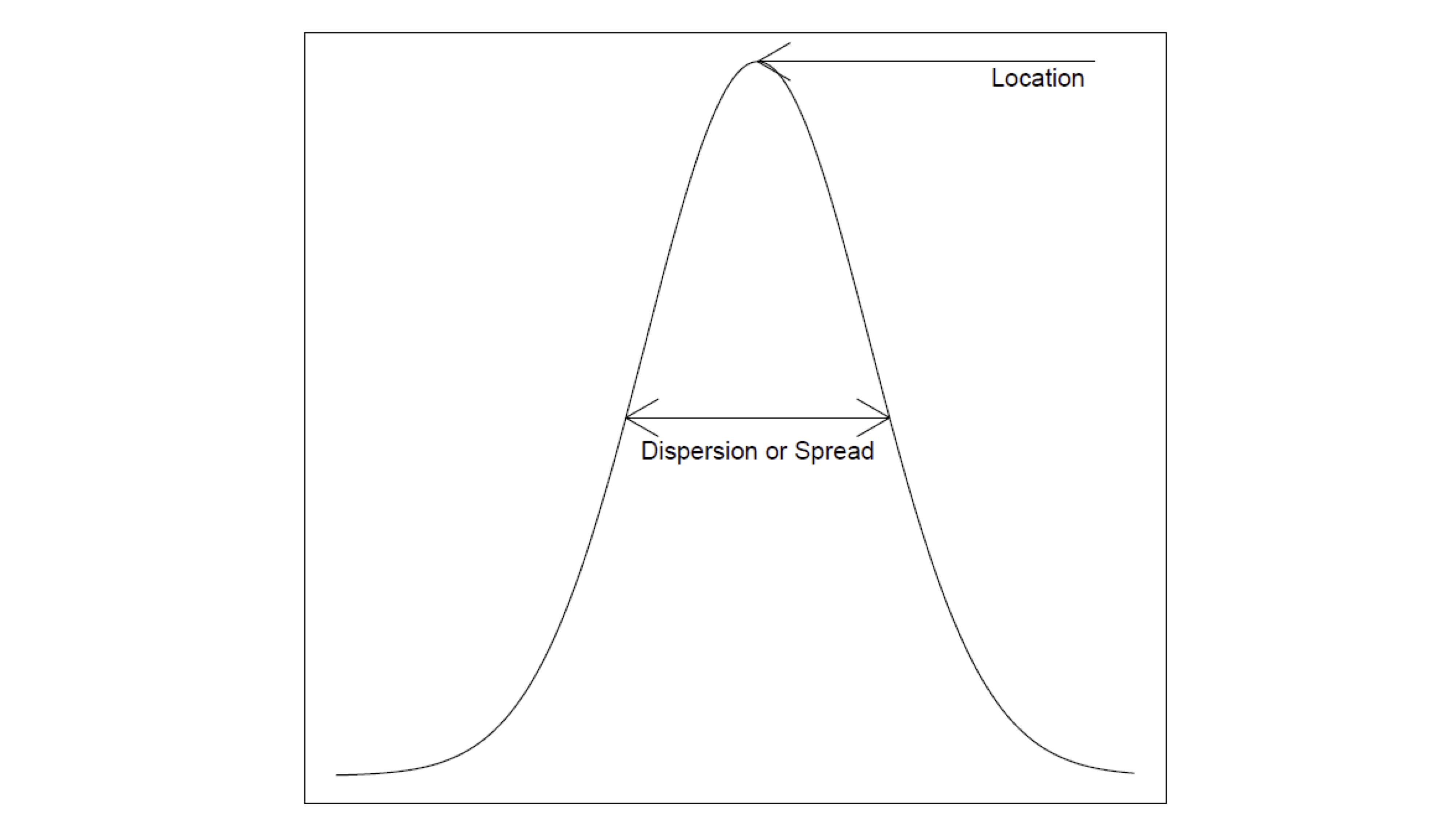
Curve represents data distribution
Question 2 – Regression
Basic question in regression:
What happens to Y as X increases?
- increases?
- decreases?
- nothing?
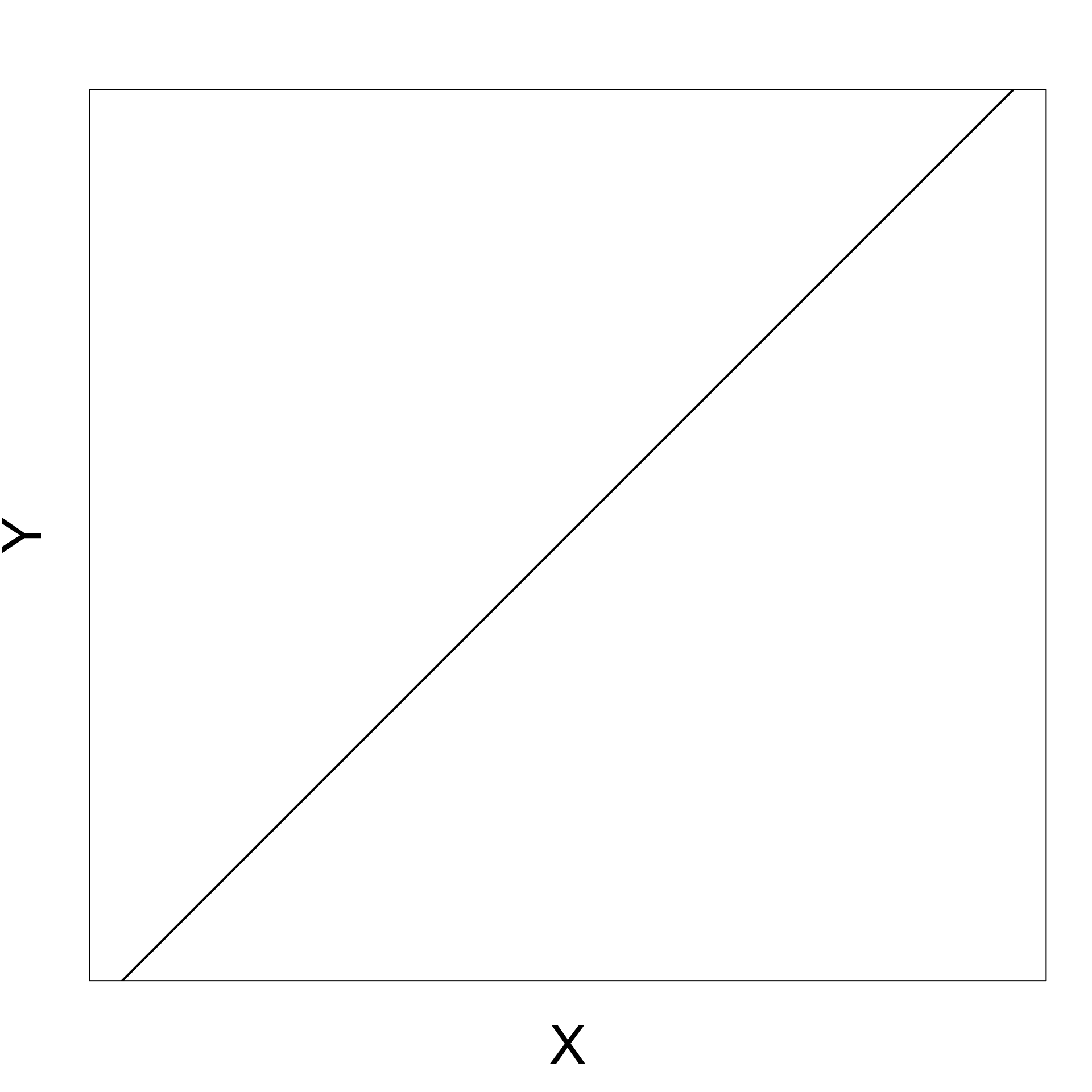
Regression can be seen as the probabilistic version of (deterministic) linear correlation
Positive gradient
As X increases Y increases
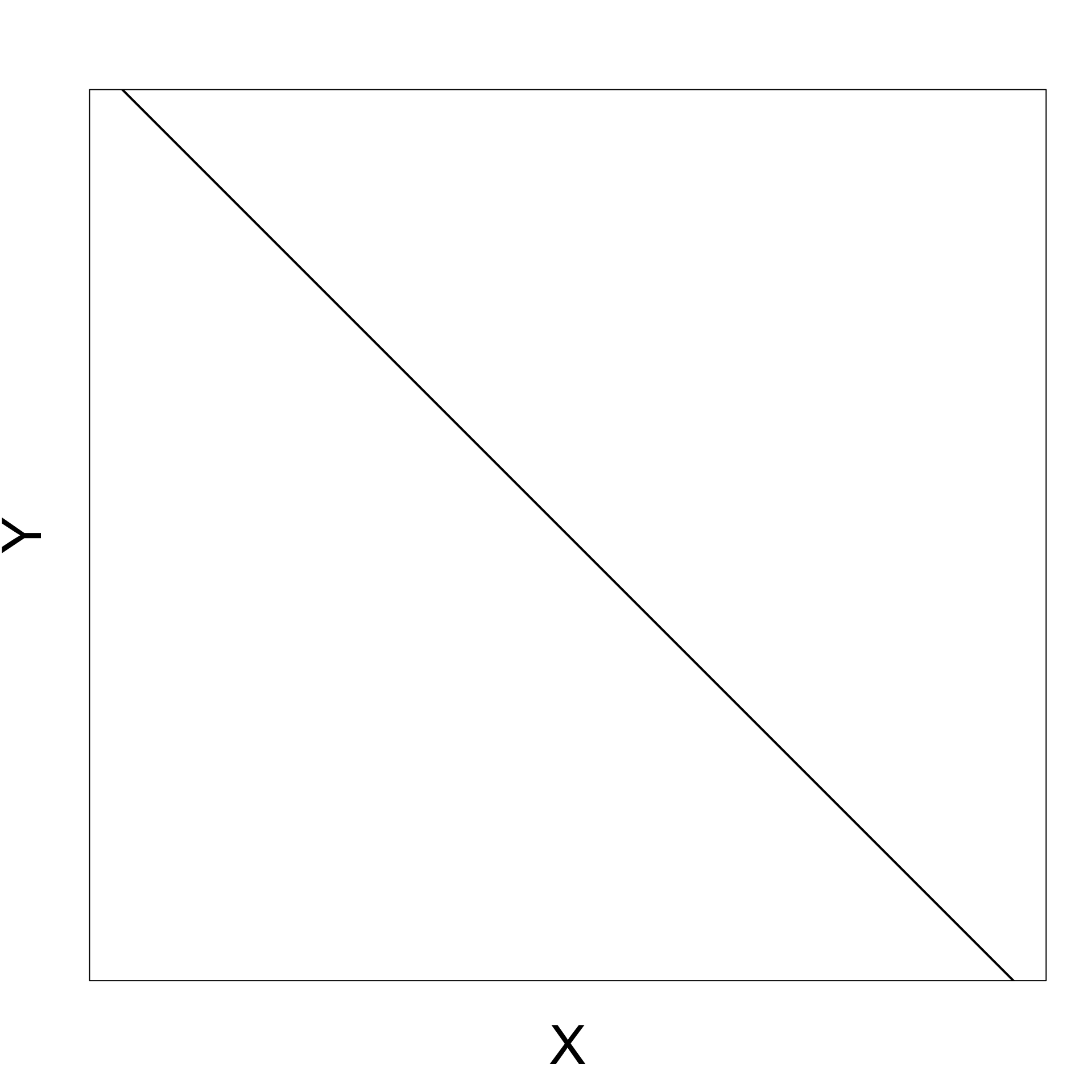
Negative gradient
As X increases Y decreases
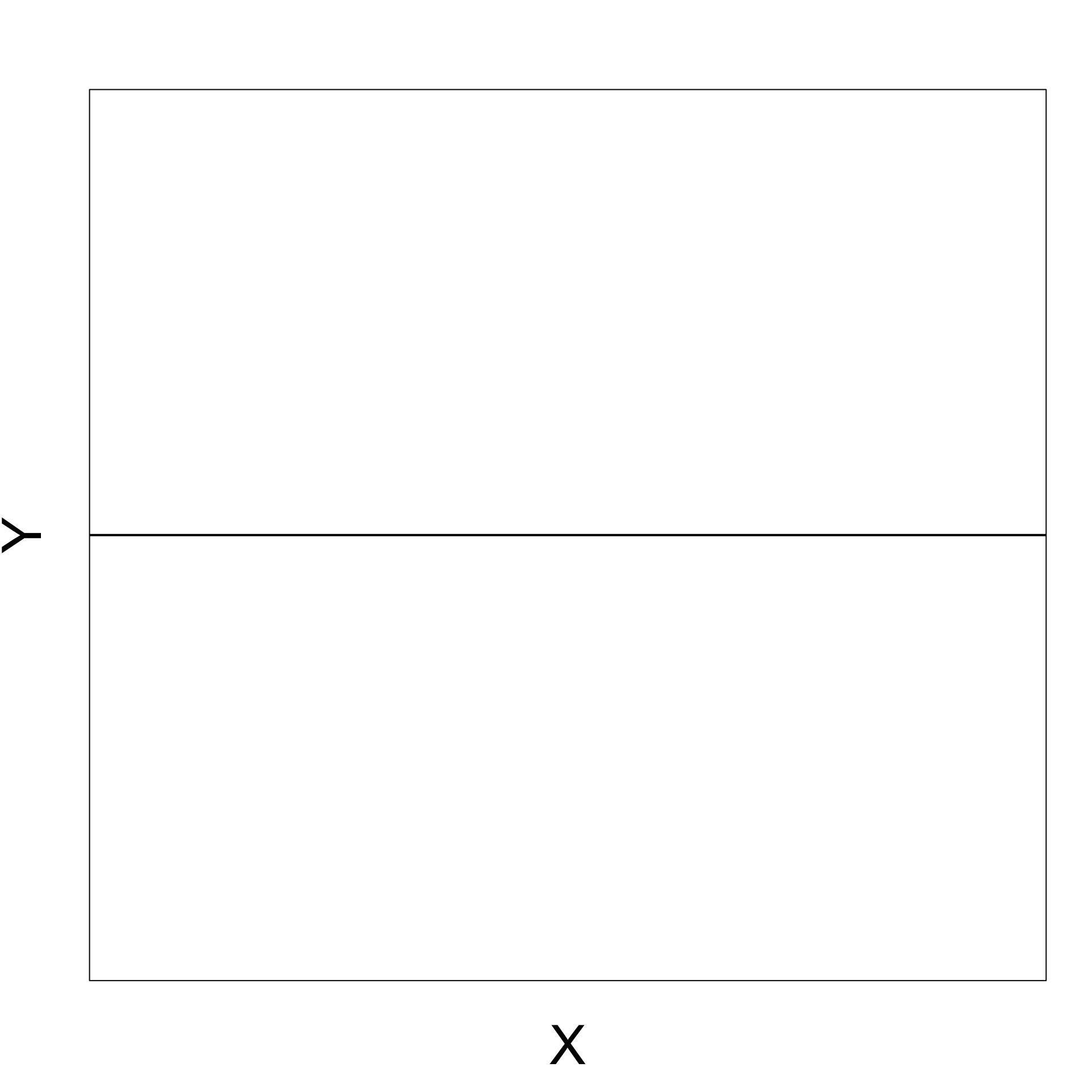
Zero gradient
Changes in X do not affect Y
Real data example
- Real data is more imperfect
- But the same basic idea applies
- Example:
- X = Stock price
- Y = Gold price
Real data example
How does real data look like?
Dataset with 33 entries for Gold and Stock price pairs
|
|
|
Real data example
Visualizing the data: Plot Stock Price VS Gold Price
- Observation:
- As Stock price decreases, Gold price increases
- Why? This might be because:
- As Stock price decreases,
- People invest in secure assets (Gold),
- Gold demand increases,
- Gold price increases
Real data example
Visualizing the data: Plot Stock Price VS Gold Price
Inverse proportionality relation evident for dataset
Question:
- How likely are we to observe it on new data?
Regression gives rigorous answer

Part 3:
Probability revision I
Probability revision I
You are expected to be familiar with the main concepts from Y1 module
Introduction to Probability & StatisticsSelf-contained revision material available in Appendix A
Topics to review: Sections 1–3 of Appendix A
- Sample space
- Events
- Probability measure
- Conditional probability
- Events independence
- Random Variable (Discrete and Continuous)
- Distribution
- cdf, pmf, pdf
- Expected value and Variance
Summary - Random Variables
Given probability space (\Omega, \mathcal{B}, P) and a Random Variable X \colon \Omega \to \mathbb{R}
Cumulative Density Function (cdf): F_X(x) := P(X \leq x)
| Discrete RV | Continuous RV |
|---|---|
| F_X has jumps | F_X is continuous |
| Probability Mass Function (pmf) | Probability Density Function (pdf) |
| f_X(x) := P(X=x) | f_X(x) := F_X'(x) |
| f_X \geq 0 | f_X \geq 0 |
| \sum_{x=-\infty}^\infty f_X(x) = 1 | \int_{-\infty}^\infty f_X(x) \, dx = 1 |
| F_X (x) = \sum_{k=-\infty}^x f_X(k) | F_X (x) = \int_{-\infty}^x f_X(t) \, dt |
| P(a \leq X \leq b) = \sum_{k = a}^{b} f_X(k) | P(a \leq X \leq b) = \int_a^b f_X(t) \, dt |
Expected Value
- Suppose X \colon \Omega \to \mathbb{R} is RV and g \colon \mathbb{R}\to \mathbb{R} a function
- Then g(X) \colon \Omega \to \mathbb{R} is a RV
Definition
The expected value of the random variable g(X) is
\begin{align*} {\rm I\kern-.3em E}[g(X)] & := \sum_{x} g(x) f_X(x) = \sum_{x \in \mathbb{R}} g(x) P(X = x) \quad \text{ if } X \text{ discrete} \\ {\rm I\kern-.3em E}[g(X)] & := \int_{-\infty}^{\infty} g(x) f_X(x) \, dx \quad \text{ if } X \text{ continuous} \end{align*}
Expected Value
Properties
In particular we have1
If X discrete {\rm I\kern-.3em E}[X] = \sum_{x \in \mathbb{R}} x f_X(x) = \sum_{x \in \mathbb{R}} x P(X = x)
If X continuous {\rm I\kern-.3em E}[X] = \int_{-\infty}^{\infty} x f_X(x) \, dx
Expected Value
Expected value is linear
Theorem
Let X be a rv, and a,b \in \mathbb{R} constants. Then
{\rm I\kern-.3em E}[aX + b] = a {\rm I\kern-.3em E}[X] + b
Variance
Variance measures how much a rv X deviates from {\rm I\kern-.3em E}[X]
Definition: Variance
The variance of a random variable X is
{\rm Var}[X]:= {\rm I\kern-.3em E}[(X - {\rm I\kern-.3em E}[X])^2]
Proposition: Equivalent formula
{\rm Var}[X] = {\rm I\kern-.3em E}[X^2] - {\rm I\kern-.3em E}[X]^2
Variance
Variance is quadratic
Proposition
X rv and a,b \in \mathbb{R}. Then
{\rm Var}[a X + b] = a^2 {\rm Var}[X]
Example - Gamma distribution
Definition
The Gamma distribution with parameters \alpha,\beta>0 is f(x) := \frac{x^{\alpha-1} e^{-\beta{x}} \beta^{\alpha}}{\Gamma(\alpha)} \,, \quad x > 0 where \Gamma is the Gamma function \Gamma(a) :=\int_0^{\infty} x^{a-1} e^{-x} \, dx
Example - Gamma distribution
Definition
Properties of \Gamma:
The Gamma function coincides with the factorial on natural numbers \Gamma(n)=(n-1)! \,, \quad \forall \, n \in \mathbb{N}
More in general \Gamma(a)=(a-1)\Gamma(a-1) \,, \quad \forall \, a > 0
Definition of \Gamma implies normalization of the Gamma distribution: \int_0^{\infty} f(x) \,dx = \int_0^{\infty} \frac{x^{\alpha-1} e^{-\beta{x}} \beta^{\alpha}}{\Gamma(\alpha)} \, dx = 1
Example - Gamma distribution
Definition
X has Gamma distribution with parameters \alpha,\beta if
the pdf of X is f_X(x) = \begin{cases} \dfrac{x^{\alpha-1} e^{-\beta{x}} \beta^{\alpha}}{\Gamma(\alpha)} & \text{ if } x > 0 \\ 0 & \text{ if } x \leq 0 \end{cases}
In this case we write X \sim \Gamma(\alpha,\beta)
\alpha is shape parameter
\beta is rate parameter
Example - Gamma distribution
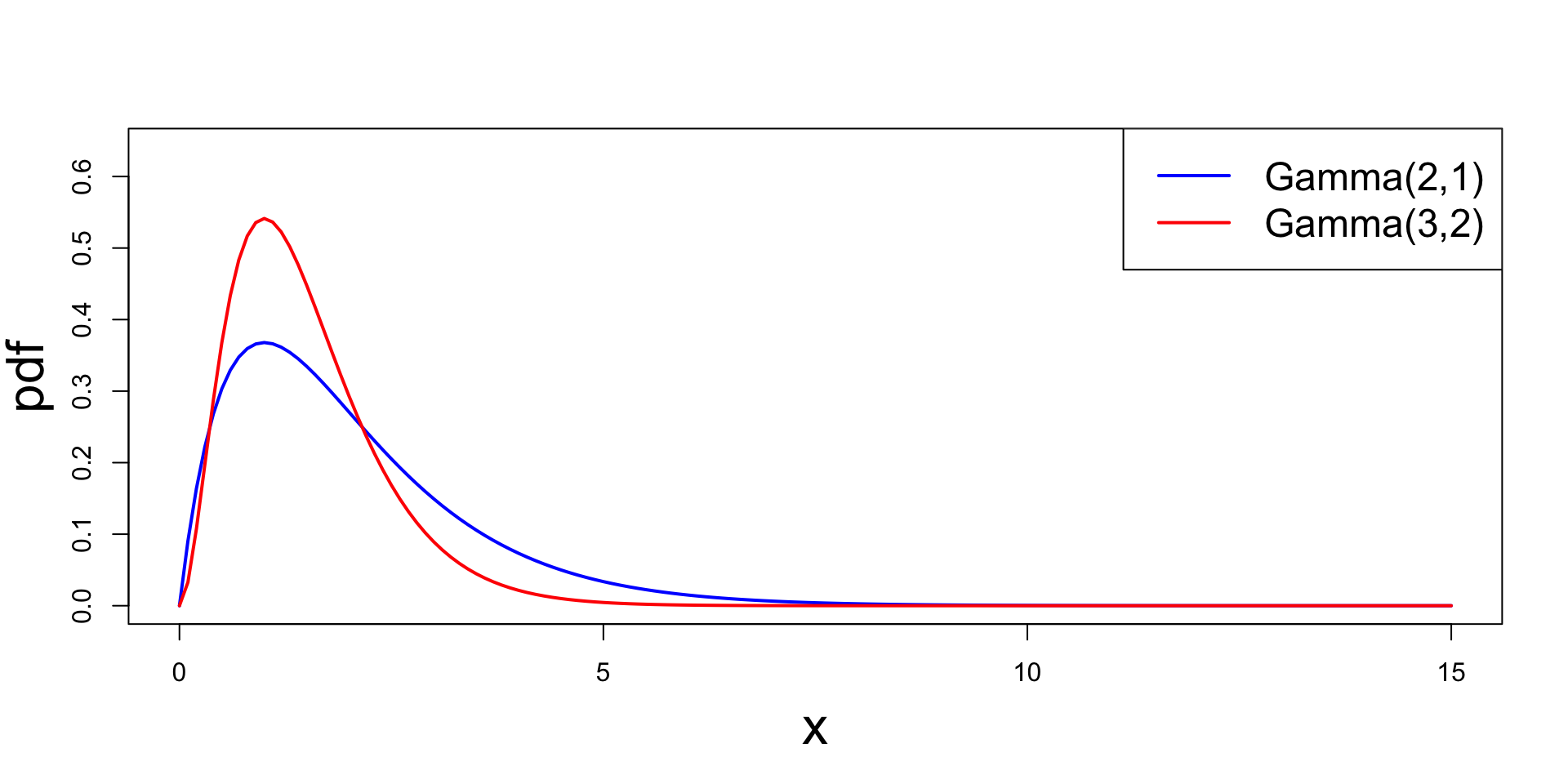
Plot
Plotting \Gamma(\alpha,\beta) for parameters (2,1) and (3,2)
Example - Gamma distribution
Expected value
Let X \sim \Gamma(\alpha,\beta). We have: \begin{align*} {\rm I\kern-.3em E}[X] & = \int_{-\infty}^\infty x f_X(x) \, dx \\ & = \int_0^\infty x \, \frac{x^{\alpha-1} e^{-\beta{x}} \beta^{\alpha}}{\Gamma(\alpha)} \, dx \\ & = \frac{ \beta^{\alpha} }{ \Gamma(\alpha) } \int_0^\infty x^{\alpha} e^{-\beta{x}} \, dx \end{align*}
Example - Gamma distribution
Expected value
Recall previous calculation: {\rm I\kern-.3em E}[X] = \frac{ \beta^{\alpha} }{ \Gamma(\alpha) } \int_0^\infty x^{\alpha} e^{-\beta{x}} \, dx Change variable y=\beta x and recall definition of \Gamma: \begin{align*} \int_0^\infty x^{\alpha} e^{-\beta{x}} \, dx & = \int_0^\infty \frac{1}{\beta^{\alpha}} (\beta x)^{\alpha} e^{-\beta{x}} \frac{1}{\beta} \, \beta \, dx \\ & = \frac{1}{\beta^{\alpha+1}} \int_0^\infty y^{\alpha} e^{-y} \, dy \\ & = \frac{1}{\beta^{\alpha+1}} \Gamma(\alpha+1) \end{align*}
Example - Gamma distribution
Expected value
Therefore \begin{align*} {\rm I\kern-.3em E}[X] & = \frac{ \beta^{\alpha} }{ \Gamma(\alpha) } \int_0^\infty x^{\alpha} e^{-\beta{x}} \, dx \\ & = \frac{ \beta^{\alpha} }{ \Gamma(\alpha) } \, \frac{1}{\beta^{\alpha+1}} \Gamma(\alpha+1) \\ & = \frac{\Gamma(\alpha+1)}{\beta \Gamma(\alpha)} \end{align*}
Recalling that \Gamma(\alpha+1)=\alpha \Gamma(\alpha): {\rm I\kern-.3em E}[X] = \frac{\Gamma(\alpha+1)}{\beta \Gamma(\alpha)} = \frac{\alpha}{\beta}
Example - Gamma distribution
Variance
We want to compute {\rm Var}[X] = {\rm I\kern-.3em E}[X^2] - {\rm I\kern-.3em E}[X]^2
- We already have {\rm I\kern-.3em E}[X]
- Need to compute {\rm I\kern-.3em E}[X^2]
Example - Gamma distribution
Variance
Proceeding similarly we have:
\begin{align*} {\rm I\kern-.3em E}[X^2] & = \int_{-\infty}^{\infty} x^2 f_X(x) \, dx \\ & = \int_{0}^{\infty} x^2 \, \frac{ x^{\alpha-1} \beta^{\alpha} e^{- \beta x} }{ \Gamma(\alpha) } \, dx \\ & = \frac{\beta^{\alpha}}{\Gamma(\alpha)} \int_{0}^{\infty} x^{\alpha+1} e^{- \beta x} \, dx \end{align*}
Example - Gamma distribution
Variance
Recall previous calculation: {\rm I\kern-.3em E}[X^2] = \frac{\beta^{\alpha}}{\Gamma(\alpha)} \int_{0}^{\infty} x^{\alpha+1} e^{- \beta x} \, dx Change variable y=\beta x and recall definition of \Gamma: \begin{align*} \int_0^\infty x^{\alpha+1} e^{-\beta{x}} \, dx & = \int_0^\infty \frac{1}{\beta^{\alpha+1}} (\beta x)^{\alpha + 1} e^{-\beta{x}} \frac{1}{\beta} \, \beta \, dx \\ & = \frac{1}{\beta^{\alpha+2}} \int_0^\infty y^{\alpha + 1 } e^{-y} \, dy \\ & = \frac{1}{\beta^{\alpha+2}} \Gamma(\alpha+2) \end{align*}
Example - Gamma distribution
Variance
Therefore {\rm I\kern-.3em E}[X^2] = \frac{ \beta^{\alpha} }{ \Gamma(\alpha) } \int_0^\infty x^{\alpha+1} e^{-\beta{x}} \, dx = \frac{ \beta^{\alpha} }{ \Gamma(\alpha) } \, \frac{1}{\beta^{\alpha+2}} \Gamma(\alpha+2) = \frac{\Gamma(\alpha+2)}{\beta^2 \Gamma(\alpha)} Now use following formula twice \Gamma(\alpha+1)=\alpha \Gamma(\alpha): \Gamma(\alpha+2)= (\alpha + 1) \Gamma(\alpha + 1) = (\alpha + 1) \alpha \Gamma(\alpha) Substituting we get {\rm I\kern-.3em E}[X^2] = \frac{\Gamma(\alpha+2)}{\beta^2 \Gamma(\alpha)} = \frac{(\alpha+1) \alpha}{\beta^2}
Example - Gamma distribution
Variance
Therefore {\rm I\kern-.3em E}[X] = \frac{\alpha}{\beta} \quad \qquad {\rm I\kern-.3em E}[X^2] = \frac{(\alpha+1) \alpha}{\beta^2} and the variance is \begin{align*} {\rm Var}[X] & = {\rm I\kern-.3em E}[X^2] - {\rm I\kern-.3em E}[X]^2 \\ & = \frac{(\alpha+1) \alpha}{\beta^2} - \frac{\alpha^2}{\beta^2} \\ & = \frac{\alpha}{\beta^2} \end{align*}
Part 4:
Moment generating functions
Moment generating function
We abbreviate Moment generating function with MGF
MGF provides a short-cut to calculating mean and variance
Definition
The moment generating function or MGF of a rv X is
M_X(t) := {\rm I\kern-.3em E}[e^{tX}] \,, \quad \forall \, t \in \mathbb{R}
In particular we have:
- X discrete: M_X(t) = \sum_{x \in \mathbb{R}} e^{tx} f_X(x)
- X continuous: M_X(t) = \int_{-\infty}^\infty e^{tx} f_X(x) \, dx
Moment generating function
Computing moments
Theorem
If X has MGF M_X then
{\rm I\kern-.3em E}[X^n] = M_X^{(n)} (0)
where we denote
M_X^{(n)} (0) := \frac{d^n}{dt^n} M_X^{(n)}(t) \bigg|_{t=0}
The quantity {\rm I\kern-.3em E}[X^n] is called n-th moment of X
Moment generating function
Proof of Theorem
Suppose X continuous and that we can exchange derivative and integral: \begin{align*} \frac{d}{dt} M_X(t) & = \frac{d}{dt} \int_{-\infty}^\infty e^{tx} f_X(x) \, dx = \int_{-\infty}^\infty \left( \frac{d}{dt} e^{tx} \right) f_X(x) \, dx \\ & = \int_{-\infty}^\infty xe^{tx} f_X(x) \, dx = {\rm I\kern-.3em E}(Xe^{tX}) \end{align*} Evaluating at t = 0: \frac{d}{dt} M_X(t) \bigg|_{t = 0} = {\rm I\kern-.3em E}(Xe^{0}) = {\rm I\kern-.3em E}[X]
Moment generating function
Proof of Theorem
Proceeding by induction we obtain: \frac{d^n}{dt^n} M_X(t) = {\rm I\kern-.3em E}(X^n e^{tX}) Evaluating at t = 0 yields the thesis: \frac{d^n}{dt^n} M_X(t) \bigg|_{t = 0} = {\rm I\kern-.3em E}(X^n e^{0}) = {\rm I\kern-.3em E}[X^n]
Moment generating function
Notation
For the first 3 derivatives we use special notations:
M_X'(0) := M^{(1)}_X(0) = {\rm I\kern-.3em E}[X] M_X''(0) := M^{(2)}_X(0) = {\rm I\kern-.3em E}[X^2] M_X'''(0) := M^{(3)}_X(0) = {\rm I\kern-.3em E}[X^3]
Example - Normal distribution
Definition
The normal distribution with mean \mu and variance \sigma^2 is f(x) := \frac{1}{\sqrt{2\pi\sigma^2}} \, \exp\left( -\frac{(x-\mu)^2}{2\sigma^2}\right) \,, \quad x \in \mathbb{R}
X has normal distribution with mean \mu and variance \sigma^2 if f_X = f
- In this case we write X \sim N(\mu,\sigma^2)
The standard normal distribution is denoted N(0,1)
Example - Normal distribution
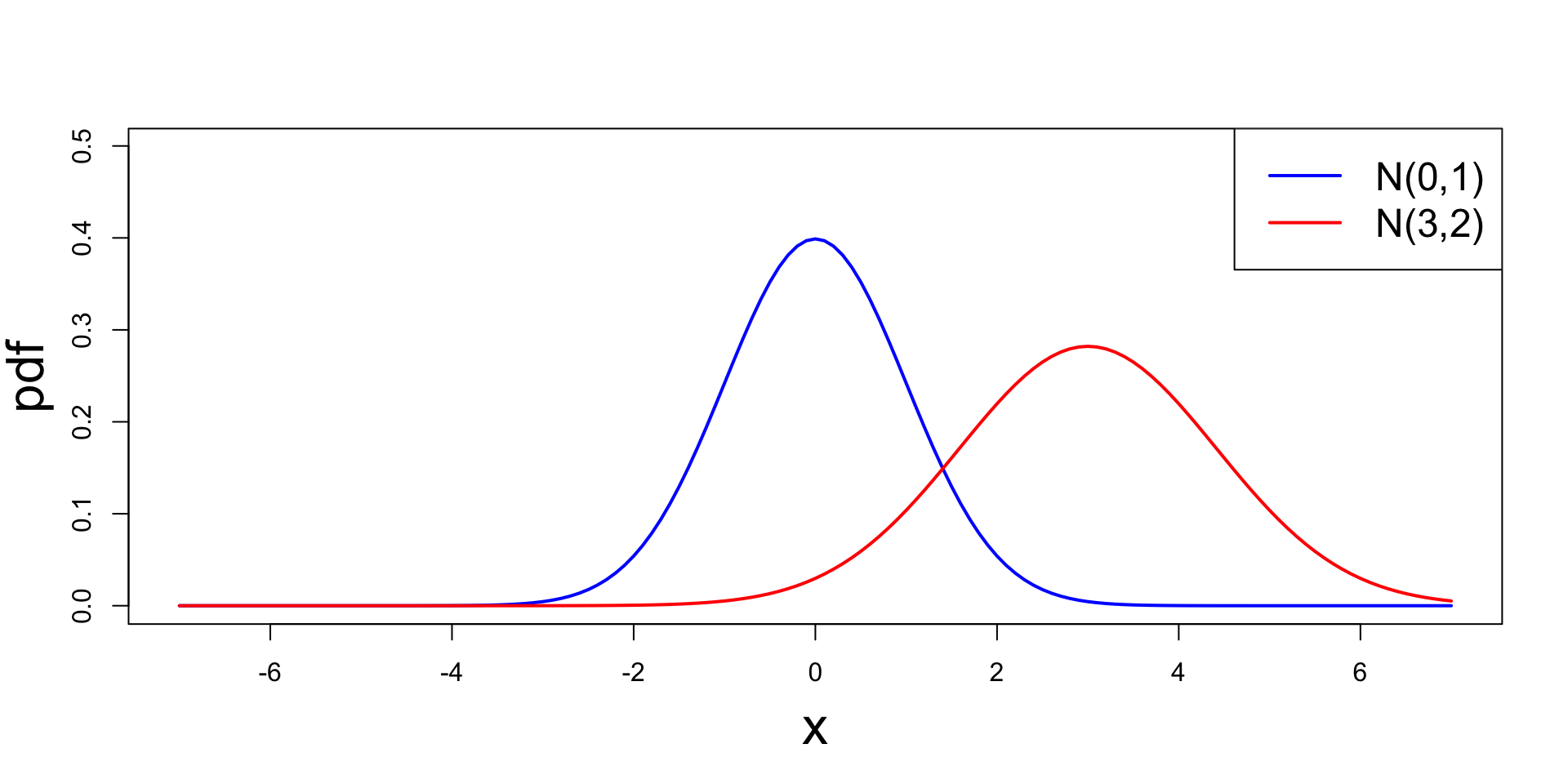
Plot
Plotting N(\mu,\sigma^2) for parameters (0,1) and (3,2)
Example - Normal distribution
Moment generating function
The equation for the normal pdf is f_X(x) = \frac{1}{\sqrt{2\pi\sigma^2}} \, \exp\left(-\frac{(x-\mu)^2}{2\sigma^2}\right) Being pdf, we must have \int f_X(x) \, dx = 1. This yields: \begin{equation} \tag{1} \int_{-\infty}^{\infty} \exp \left( -\frac{x^2}{2\sigma^2} + \frac{\mu{x}}{\sigma^2} \right) \, dx = \exp \left(\frac{\mu^2}{2\sigma^2} \right) \sqrt{2\pi} \sigma \end{equation}
Example - Normal distribution
Moment generating function
We have \begin{align*} M_X(t) & := {\rm I\kern-.3em E}(e^{tX}) = \int_{-\infty}^{\infty} e^{tx} f_X(x) \, dx \\ & = \int_{-\infty}^{\infty} e^{tx} \frac{1}{\sqrt{2\pi}\sigma} \exp \left( -\frac{(x-\mu)^2}{2\sigma^2} \right) \, dx \\ & = \frac{1}{\sqrt{2\pi}\sigma} \int_{-\infty}^{\infty} e^{tx} \exp \left( -\frac{x^2}{2\sigma^2} - \frac{\mu^2}{2\sigma^2} + \frac{x\mu}{\sigma^2} \right) \, dx \\ & = \exp\left(-\frac{\mu^2}{2\sigma^2} \right) \frac{1}{\sqrt{2\pi}\sigma} \int_{-\infty}^{\infty} \exp \left(- \frac{x^2}{2\sigma^2} + \frac{(t\sigma^2+\mu) x}{\sigma^2} \right) \, dx \end{align*}
Example - Normal distribution
Moment generating function
We have shown \begin{equation} \tag{2} M_X(t) = \exp\left(-\frac{\mu^2}{2\sigma^2} \right) \frac{1}{\sqrt{2\pi}\sigma} \int_{-\infty}^{\infty} \exp \left(- \frac{x^2}{2\sigma^2} + \frac{(t\sigma^2+\mu) x}{\sigma^2} \right) \, dx \end{equation} Replacing \mu by (t\sigma^2 + \mu) in (1) we obtain \begin{equation} \tag{3} \int_{-\infty}^{\infty} \exp \left(- \frac{x^2}{2\sigma^2} + \frac{(t\sigma^2+\mu) x}{\sigma^2} \right) \, dx = \exp \left( \frac{(t\sigma^2+\mu)^2}{2\sigma^2} \right) \, \sqrt{2\pi}\sigma \end{equation} Substituting (3) in (2) and simplifying we get M_X(t) = \exp \left( \mu t + \frac{t^2 \sigma^2}{2} \right)
Example - Normal distribution
Mean
Recall the mgf M_X(t) = \exp \left( \mu t + \frac{t^2 \sigma^2}{2} \right) The first derivative is M_X'(t) = (\mu + \sigma^2 t ) \exp \left( \mu t + \frac{t^2 \sigma^2}{2} \right) Therefore the mean: {\rm I\kern-.3em E}[X] = M_X'(0) = \mu
Example - Normal distribution
Variance
The first derivative of mgf is M_X'(t) = (\mu + \sigma^2 t ) \exp \left( \mu t + \frac{t^2 \sigma^2}{2} \right) The second derivative is then M_X''(t) = \sigma^2 \exp \left( \mu t + \frac{t^2 \sigma^2}{2} \right) + (\mu + \sigma^2 t )^2 \exp \left( \mu t + \frac{t^2 \sigma^2}{2} \right) Therefore the second moment is: {\rm I\kern-.3em E}[X^2] = M_X''(0) = \sigma^2 + \mu^2
Example - Normal distribution
Variance
We have seen that: {\rm I\kern-.3em E}[X] = \mu \quad \qquad {\rm I\kern-.3em E}[X^2] = \sigma^2 + \mu^2 Therefore the variance is: \begin{align*} {\rm Var}[X] & = {\rm I\kern-.3em E}[X^2] - {\rm I\kern-.3em E}[X]^2 \\ & = \sigma^2 + \mu^2 - \mu^2 \\ & = \sigma^2 \end{align*}
Example - Gamma distribution
Moment generating function
Suppose X \sim \Gamma(\alpha,\beta). This means f_X(x) = \begin{cases} \dfrac{x^{\alpha-1} e^{-\beta{x}} \beta^{\alpha}}{\Gamma(\alpha)} & \text{ if } x > 0 \\ 0 & \text{ if } x \leq 0 \end{cases}
We have seen already that {\rm I\kern-.3em E}[X] = \frac{\alpha}{\beta} \quad \qquad {\rm Var}[X] = \frac{\alpha}{\beta^2}
We want to compute mgf M_X to derive again {\rm I\kern-.3em E}[X] and {\rm Var}[X]
Example - Gamma distribution
Moment generating function
We compute \begin{align*} M_X(t) & = {\rm I\kern-.3em E}[e^{tX}] = \int_{-\infty}^\infty e^{tx} f_X(x) \, dx \\ & = \int_0^{\infty} e^{tx} \, \frac{x^{\alpha-1}e^{-\beta{x}} \beta^{\alpha}}{\Gamma(\alpha)} \, dx \\ & = \frac{\beta^{\alpha}}{\Gamma(\alpha)}\int_0^{\infty}x^{\alpha-1}e^{-(\beta-t)x} \, dx \end{align*}
Example - Gamma distribution
Moment generating function
From the previous slide we have M_X(t) = \frac{\beta^{\alpha}}{\Gamma(\alpha)}\int_0^{\infty}x^{\alpha-1}e^{-(\beta-t)x} \, dx Change variable y=(\beta-t)x and recall the definition of \Gamma: \begin{align*} \int_0^{\infty} x^{\alpha-1} e^{-(\beta-t)x} \, dx & = \int_0^{\infty} \frac{1}{(\beta-t)^{\alpha-1}} [(\beta-t)x]^{\alpha-1} e^{-(\beta-t)x} \frac{1}{(\beta-t)} (\beta - t) \, dx \\ & = \frac{1}{(\beta-t)^{\alpha}} \int_0^{\infty} y^{\alpha-1} e^{-y} \, dy \\ & = \frac{1}{(\beta-t)^{\alpha}} \Gamma(\alpha) \end{align*}
Example - Gamma distribution
Moment generating function
Therefore \begin{align*} M_X(t) & = \frac{\beta^{\alpha}}{\Gamma(\alpha)}\int_0^{\infty}x^{\alpha-1}e^{-(\beta-t)x} \, dx \\ & = \frac{\beta^{\alpha}}{\Gamma(\alpha)} \cdot \frac{1}{(\beta-t)^{\alpha}} \Gamma(\alpha) \\ & = \frac{\beta^{\alpha}}{(\beta-t)^{\alpha}} \end{align*}
Example - Gamma distribution
Expectation
From the mgf M_X(t) = \frac{\beta^{\alpha}}{(\beta-t)^{\alpha}} we compute the first derivative: \begin{align*} M_X'(t) & = \frac{d}{dt} [\beta^{\alpha}(\beta-t)^{-\alpha}] \\ & = \beta^{\alpha}(-\alpha)(\beta-t)^{-\alpha-1}(-1) \\ & = \alpha\beta^{\alpha}(\beta-t)^{-\alpha-1} \end{align*}
Example - Gamma distribution
Expectation
From the first derivative M_X'(t) = \alpha\beta^{\alpha}(\beta-t)^{-\alpha-1} we compute the expectation \begin{align*} {\rm I\kern-.3em E}[X] & = M_X'(0) \\ & = \alpha\beta^{\alpha}(\beta)^{-\alpha-1} \\ & =\frac{\alpha}{\beta} \end{align*}
Example - Gamma distribution
Variance
From the first derivative M_X'(t) = \alpha\beta^{\alpha}(\beta-t)^{-\alpha-1} we compute the second derivative \begin{align*} M_X''(t) & = \frac{d}{dt}[\alpha\beta^{\alpha}(\beta-t)^{-\alpha-1}] \\ & = \alpha\beta^{\alpha}(-\alpha-1)(\beta-t)^{-\alpha-2}(-1)\\ & = \alpha(\alpha+1)\beta^{\alpha}(\beta-t)^{-\alpha-2} \end{align*}
Example - Gamma distribution
Variance
From the second derivative M_X''(t) = \alpha(\alpha+1)\beta^{\alpha}(\beta-t)^{-\alpha-2} we compute the second moment: \begin{align*} {\rm I\kern-.3em E}[X^2] & = M_X''(0) \\ & = \alpha(\alpha+1)\beta^{\alpha}(\beta)^{-\alpha-2} \\ & = \frac{\alpha(\alpha + 1)}{\beta^2} \end{align*}
Example - Gamma distribution
Variance
From the first and second moments: {\rm I\kern-.3em E}[X] = \frac{\alpha}{\beta} \qquad \qquad {\rm I\kern-.3em E}[X^2] = \frac{\alpha(\alpha + 1)}{\beta^2} we can compute the variance \begin{align*} {\rm Var}[X] & = {\rm I\kern-.3em E}[X^2] - {\rm I\kern-.3em E}[X]^2 \\ & = \frac{\alpha(\alpha + 1)}{\beta^2} - \frac{\alpha^2}{\beta^2} \\ & = \frac{\alpha}{\beta^2} \end{align*}
Moment generating function
The mgf characterizes a distribution
Theorem
Let X and Y be random variables with mgfs M_X and M_Y respectively. Assume there exists \varepsilon>0 such that
M_X(t) = M_Y(t) \,, \quad \forall \, t \in (-\varepsilon, \varepsilon)
Then X and Y have the same cdf
F_X(u) = F_Y(u) \,, \quad \forall \, x \in \mathbb{R}
In other words: \qquad same mgf \quad \implies \quad same distribution
Example
Suppose X is a random variable such that M_X(t) = \exp \left( \mu t + \frac{t^2 \sigma^2}{2} \right) As the above is the mgf of a normal distribution, by the previous Theorem we infer X \sim N(\mu,\sigma^2)
Suppose Y is a random variable such that M_Y(t) = \frac{\beta^{\alpha}}{(\beta-t)^{\alpha}} As the above is the mgf of a Gamma distribution, by the previous Theorem we infer Y \sim \Gamma(\alpha,\beta)
Part 5:
Probability revision II
Probability revision II
You are expected to be familiar with the main concepts from Y1 module
Introduction to Probability & StatisticsSelf-contained revision material available in Appendix A
Topics to review: Sections 4–5 of Appendix A
- Random vectors
- Bivariate vectors
- Joint pdf and pmf
- Marginals
- Conditional distributions
- Conditional expectation
- Conditional variance
Univariate vs Bivariate vs Multivariate
- Probability models seen so far only involve 1 random variable
- These are called univariate models
- We are also interested in probability models involving multiple variables:
- Models with 2 random variables are called bivariate
- Models with more than 2 random variables are called multivariate
Random vectors
Definition
Recall: a random variable is a measurable function X \colon \Omega \to \mathbb{R}\,, \quad \Omega \,\, \text{ sample space}
Definition
A random vector is a measurable function \mathbf{X}\colon \Omega \to \mathbb{R}^n. We say that
- \mathbf{X} is univariate if n=1
- \mathbf{X} is bivariate if n=2
- \mathbf{X} is multivariate if n \geq 3
Random vectors
Notation
The components of a random vector \mathbf{X} are denoted by \mathbf{X}= (X_1, \ldots, X_n) with X_i \colon \Omega \to \mathbb{R} random variables
We denote a two-dimensional bivariate random vector by (X,Y) with X,Y \colon \Omega \to \mathbb{R} random variables
Summary - Bivariate Random Vectors
| (X,Y) discrete random vector | (X,Y) continuous random vector |
|---|---|
| X and Y discrete RV | X and Y continuous RV |
| Joint pmf | Joint pdf |
| f_{X,Y}(x,y) := P(X=x,Y=y) | P((X,Y) \in A) = \int_A f_X(x,y) \,dxdy |
| f_{X,Y} \geq 0 | f_{X,Y} \geq 0 |
| \sum_{(x,y)\in \mathbb{R}^2} f_{X,Y}(x,y)=1 | \int_{\mathbb{R}^2} f_{X,Y}(x,y) \, dxdy= 1 |
| Marginal pmfs | Marginal pdfs |
| f_X (x) := P(X=x) | P(a \leq X \leq b) = \int_a^b f_X(x) \,dx |
| f_Y (y) := P(Y=y) | P(a \leq Y \leq b) = \int_a^b f_Y(y) \,dy |
| f_X (x)=\sum_{y \in \mathbb{R}} f_{X,Y}(x,y) | f_X(x) = \int_{\mathbb{R}} f_{X,Y}(x,y) \,dy |
| f_Y (y)=\sum_{x \in \mathbb{R}} f_{X,Y}(x,y) | f_Y(y) = \int_{\mathbb{R}} f_{X,Y}(x,y) \,dx |
Expected Value
- Suppose (X,Y) \colon \Omega \to \mathbb{R}^2 is random vector and g \colon \mathbb{R}^2 \to \mathbb{R} function
- Then g(X,Y) \colon \Omega \to \mathbb{R} is random variable
Definition
The expected value of the random variable g(X,Y) is \begin{align*}
{\rm I\kern-.3em E}[g(X,Y)] & := \sum_{x,y} g(x,y) P(X=x,Y=y) \quad \text{ if } (X,Y) \text{ discrete} \\
{\rm I\kern-.3em E}[g(X,Y)] & := \int_{\mathbb{R}^2} g(x,y) f_{X,Y}(x,y) \, dxdy \quad \text{ if } (X,Y) \text{ continuous}
\end{align*}
Notation:The symbol \int_{\mathbb{R}^2} denotes the double integral \int_{-\infty}^\infty\int_{-\infty}^\infty
Conditional distributions
(X,Y) rv with joint pdf (or pmf) f_{X,Y} and marginal pdfs (or pmfs) f_X, f_Y
The conditional pdf (or pmf) of Y given that X=x is the function f(\cdot | x) f(y|x) := \frac{f_{X,Y}(x,y)}{f_X(x)} \, , \qquad \text{ whenever} \quad f_X(x)>0
The conditional pdf (or pmf) of X given that Y=y is the function f(\cdot | y) f(x|y) := \frac{f_{X,Y}(x,y)}{f_Y(y)}\, , \qquad \text{ whenever} \quad f_Y(y)>0
Notation: We will often write
- Y|X to denote the distribution f(y|x)
- X|Y to denote the distribution f(x|y)
Conditional expectation
Definition
(X,Y) random vector and g \colon \mathbb{R}\to \mathbb{R} function. The conditional expectation of g(Y) given X=x is \begin{align*}
{\rm I\kern-.3em E}[g(Y) | x] & := \sum_{y} g(y) f(y|x) \quad \text{ if } (X,Y) \text{ discrete} \\
{\rm I\kern-.3em E}[g(Y) | x] & := \int_{y \in \mathbb{R}} g(y) f(y|x) \, dy \quad \text{ if } (X,Y) \text{ continuous}
\end{align*}
- {\rm I\kern-.3em E}[g(Y) | x] is a real number for all x \in \mathbb{R}
- {\rm I\kern-.3em E}[g(Y) | X] denotes the Random Variable h(X) where h(x):={\rm I\kern-.3em E}[g(Y) | x]
Conditional variance
Definition
(X,Y) random vector. The conditional variance of Y given X=x is
{\rm Var}[Y | x] := {\rm I\kern-.3em E}[Y^2|x] - {\rm I\kern-.3em E}[Y|x]^2
- {\rm Var}[Y | x] is a real number for all x \in \mathbb{R}
- {\rm Var}[Y | X] denotes the Random Variable {\rm Var}[Y | X] := {\rm I\kern-.3em E}[Y^2|X] - {\rm I\kern-.3em E}[Y|X]^2
Exercise - Conditional distribution
Assume given a continuous random vector (X,Y) with joint pdf f_{X,Y}(x,y) := e^{-y} \,\, \text{ if } \,\, 0 < x < y \,, \quad f_{X,Y}(x,y) :=0 \,\, \text{ otherwise}
- Compute f_X and f(y|x)
- Compute {\rm I\kern-.3em E}[Y|X]
- Compute {\rm Var}[Y|X]
Solution
- We compute f_X, the marginal pdf of X:
- If x \leq 0 then f_{X,Y}(x,y)=0. Therefore f_X(x) = \int_{-\infty}^\infty f_{X,Y}(x,y) \, dy = 0
- If x > 0 then f_{X,Y}(x,y)=e^{-y} if y>x, and f_{X,Y}(x,y)=0 if y \leq x. Thus \begin{align*} f_X(x) & = \int_{-\infty}^\infty f_{X,Y}(x,y) \, dy = \int_{x}^\infty e^{-y} \, dy \\ & = - e^{-y} \bigg|_{y=x}^{y=\infty} = -e^{-\infty} + e^{-x} = e^{-x} \end{align*}
Solution
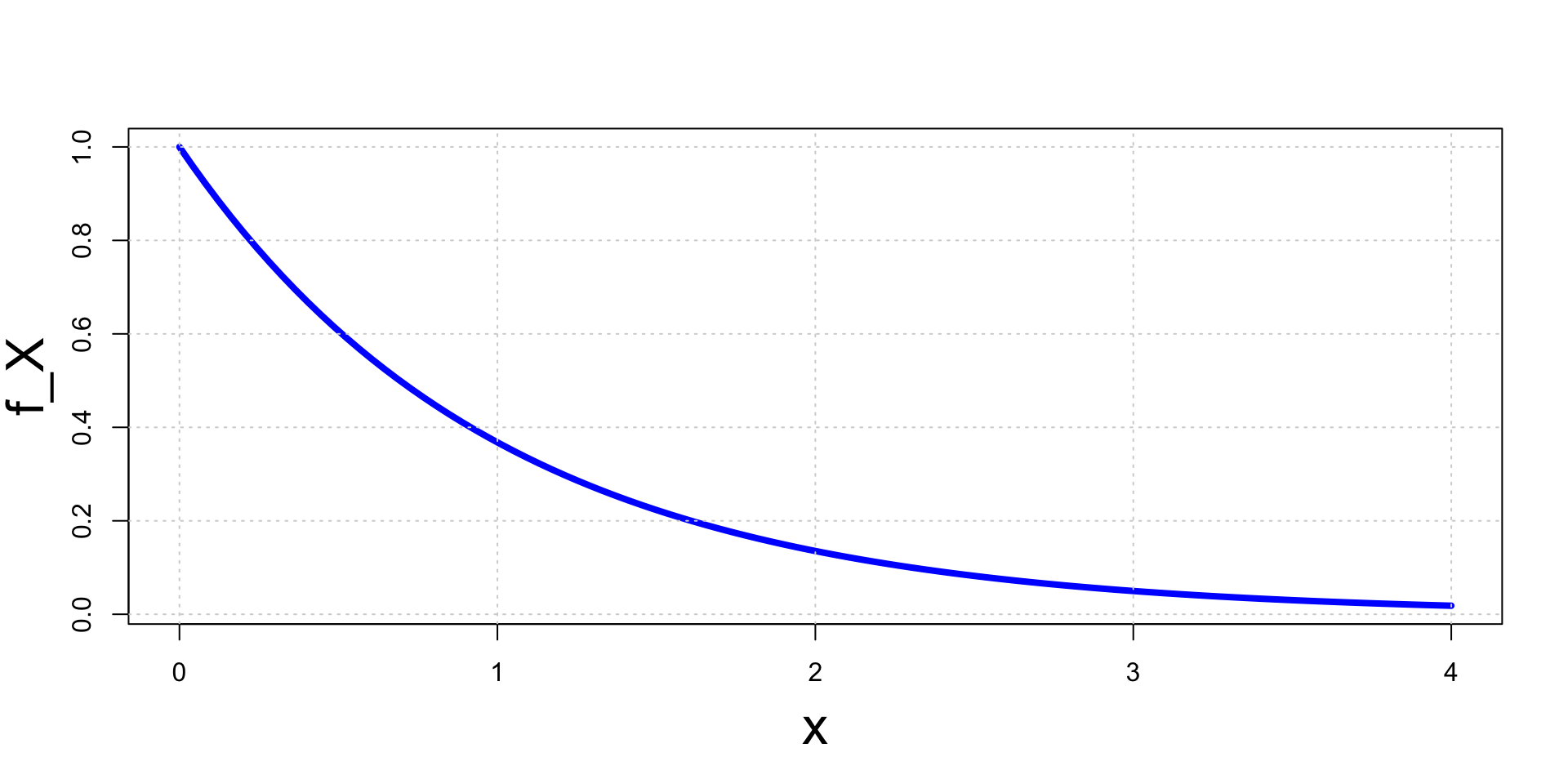
- The marginal pdf of X has then exponential distribution f_{X}(x) = \begin{cases} e^{-x} & \text{ if } x > 0 \\ 0 & \text{ if } x \leq 0 \end{cases}
Solution
- We now compute f(y|x), the conditional pdf of Y given X=x:
- Note that f_X(x)>0 for all x>0
- Hence assume fixed some x>0
- If y>x we have f_{X,Y}(x,y)=e^{-y}. Hence f(y|x) := \frac{f_{X,Y}(x,y)}{f_X(x)} = \frac{e^{-y}}{e^{-x}} = e^{-(y-x)}
- If y \leq x we have f_{X,Y}(x,y)=0. Hence f(y|x) := \frac{f_{X,Y}(x,y)}{f_X(x)} = \frac{0}{e^{-x}} = 0
Solution
The conditional distribution Y|X is therefore exponential, shifted by x f(y|x) = \begin{cases} e^{-(y-x)} & \text{ if } y > x \\ 0 & \text{ if } y \leq x \end{cases}
The conditional expectation of Y given X=x is \begin{align*} {\rm I\kern-.3em E}[Y|x] & = \int_{-\infty}^\infty y f(y|x) \, dy = \int_{x}^\infty y e^{-(y-x)} \, dy \\ & = -(y+1) e^{-(y-x)} \bigg|_{x}^\infty = x + 1 \end{align*} where we integrated by parts
Solution
Therefore conditional expectation of Y given X=x is {\rm I\kern-.3em E}[Y|x] = x + 1
This can also be interpreted as the random variable {\rm I\kern-.3em E}[Y|X] = X + 1
This is not surprising!
- The distribution of Y|X is just an exponential translated by X
- Therefore, the expected value of Y|X is the expected value of the exponential distribution, which is 1, translated by X
Solution
The conditional second moment of Y given X=x is \begin{align*} {\rm I\kern-.3em E}[Y^2|x] & = \int_{-\infty}^\infty y^2 f(y|x) \, dy = \int_{x}^\infty y^2 e^{-(y-x)} \, dy \\ & = (y^2+2y+2) e^{-(y-x)} \bigg|_{x}^\infty = x^2 + 2x + 2 \end{align*} where we integrated by parts
The conditional variance of Y given X=x is {\rm Var}[Y|x] = {\rm I\kern-.3em E}[Y^2|x] - {\rm I\kern-.3em E}[Y|x]^2 = x^2 + 2x + 2 - (x+1)^2 = 1
Solution
The conditional variance can be interpreted as the random variable {\rm Var}[Y|X] = 1
This is not surprising!
- The distribution of Y|X is just an exponential translated by X
- Therefore, the shape of the distribution does not change
- Thus, the variance of Y|X does not depend on X {\rm Var}[Y|X = x ] = {\rm Var}[Y | X = 0] = 1
Conditional Expectation
A useful formula
Theorem
(X,Y) random vector. Then
{\rm I\kern-.3em E}[X] = {\rm I\kern-.3em E}[ {\rm I\kern-.3em E}[X|Y] ]
Note: The above formula contains abuse of notation – {\rm I\kern-.3em E} has 3 meanings
- First {\rm I\kern-.3em E} is with respect to the marginal of X
- Second {\rm I\kern-.3em E} is with respect to the marginal of Y
- Third {\rm I\kern-.3em E} is with respect to the conditional distribution X|Y
Conditional Variance
A useful formula
Theorem
(X,Y) random vector. Then
{\rm Var}[X] = {\rm I\kern-.3em E}[ {\rm Var}[ X|Y] ] + {\rm Var}[{\rm I\kern-.3em E}[X|Y]]
Exercise
Let n \in \mathbb{N} be constant, and the random vector (X,Y) satisfy the following:
X has uniform distribution on [0,1], meaning that its pdf is f_X(x) = \chi_{[0,1]}(x) = \begin{cases} 1 & \, \text{ if } \, x \in [0,1] \\ 0 & \, \text{ otherwise } \end{cases}
The distribution of Y, conditional on X = x, is binomial \mathop{\mathrm{Bin}}(n,x). This means P(Y = k | X = x) = \binom{n}{k} x^k (1-x)^{n-k} \,, \quad k = 0 , 1 , \ldots ,n \,, where the binomial coefficient is \binom{n}{k} = \frac{n!}{k!(n-k)!}
Question: Compute {\rm I\kern-.3em E}[Y] and {\rm Var}[Y]
Solution
- By assumption X is uniform on [0,1]. Therefore \begin{align*} f_X(x) & = \chi_{[0,1]}(x) = \begin{cases} 1 & \, \text{ if } \, x \in [0,1] \\ 0 & \, \text{ otherwise } \end{cases} \\ {\rm I\kern-.3em E}[X] & = \int_\mathbb{R}x f_{X}(x)\, dx = \int_0^1 x \, dx = \frac12 \\ {\rm I\kern-.3em E}[X^2] & = \int_\mathbb{R}x^2 f_{X} (x)\, dx = \int_0^1 x^2 \, dx = \frac13 \\ {\rm Var}[X] & = {\rm I\kern-.3em E}[X^2] - {\rm I\kern-.3em E}[X]^2 = \frac13 - \frac{1}{4} = \frac{1}{12} \end{align*}
Solution
By assumption Y | X = x is \mathop{\mathrm{Bin}}(n,x). Using well-known formulas, we get {\rm I\kern-.3em E}[Y|X] = nX \,, \qquad {\rm Var}[Y|X] = nX(1-X)
Therefore we conclude \begin{align*} {\rm I\kern-.3em E}[Y] & = {\rm I\kern-.3em E}[ {\rm I\kern-.3em E}[Y|X] ] = {\rm I\kern-.3em E}[nX] = n {\rm I\kern-.3em E}[X] = \frac{n}{2} \\ & \phantom{s} \\ {\rm Var}[Y] & = {\rm I\kern-.3em E}[{\rm Var}[Y|X]] + {\rm Var}[{\rm I\kern-.3em E}[Y|X]] \\ & = {\rm I\kern-.3em E}[nX(1-X)] + {\rm Var}[nX] \\ & = n {\rm I\kern-.3em E}[X] - n{\rm I\kern-.3em E}[X^2] + n^2{\rm Var}[X] \\ & = \frac{n}{2} - \frac{n}{3} + \frac{n^2}{12} = \frac{n}{6} + \frac{n^2}{12} \end{align*}
Part 6:
Probability revision III
Probability revision III
You are expected to be familiar with the main concepts from Y1 module
Introduction to Probability & StatisticsSelf-contained revision material available in Appendix A
Topics to review: Sections 6–7 of Appendix A
- Independence of random variables
- Covariance and correlation
Independence of random variables
Definition: Independence
(X,Y) random vector with joint pdf or pmf f_{X,Y} and marginal pdfs or pmfs f_X,f_Y. We say that X and Y are independent random variables if
f_{X,Y}(x,y) = f_X(x)f_Y(y) \,, \quad \forall \, (x,y) \in \mathbb{R}^2
Independence of random variables
Conditional distributions and probabilities
If X and Y are independent then X gives no information on Y (and vice-versa):
Conditional distribution: Y|X is same as Y f(y|x) = \frac{f_{X,Y}(x,y)}{f_X(x)} = \frac{f_X(x)f_Y(y)}{f_X(x)} = f_Y(y)
Conditional probabilities: From the above we also obtain \begin{align*} P(Y \in A | x) & = \sum_{y \in A} f(y|x) = \sum_{y \in A} f_Y(y) = P(Y \in A) & \, \text{ discrete rv} \\ P(Y \in A | x) & = \int_{y \in A} f(y|x) \, dy = \int_{y \in A} f_Y(y) \, dy = P(Y \in A) & \, \text{ continuous rv} \end{align*}
Independence of random variables
Characterization of independence - Densities
Theorem
(X,Y) random vector with joint pdf or pmf f_{X,Y}. They are equivalent:
- X and Y are independent random variables
- There exist functions g(x) and h(y) such that f_{X,Y}(x,y) = g(x)h(y) \,, \quad \forall \, (x,y) \in \mathbb{R}^2
Note:
- g(x) and h(y) are not necessarily the pdfs or pmfs of X and Y
- However they coincide with f_X and f_Y, up to rescaling by a constant
Exercise
A student leaves for class between 8 AM and 8:30 AM and takes between 40 and 50 minutes to get there
Denote by X the time of departure
- X = 0 corresponds to 8 AM
- X = 30 corresponds to 8:30 AM
Denote by Y the travel time
Assume that X and Y are independent and uniformly distributed
Question: Find the probability that the student arrives to class before 9 AM
Solution
By assumption X is uniform on (0,30). Therefore f_X(x) = \begin{cases} \frac{1}{30} & \text{ if } \, x \in (0,30) \\ 0 & \text{ otherwise } \end{cases}
By assumption Y is uniform on (40,50). Therefore f_Y(y) = \begin{cases} \frac{1}{10} & \text{ if } \, y \in (40,50) \\ 0 & \text{ otherwise } \end{cases} where we used that 50 - 40 = 10
Solution
Define the rectangle R = (0,30) \times (40,50)
Since X and Y are independent, we get
f_{X,Y}(x,y) = f_X(x)f_Y(y) = \begin{cases} \frac{1}{300} & \text{ if } \, (x,y) \in R \\ 0 & \text{ otherwise } \end{cases}
Solution
The arrival time is given by X + Y
Therefore, the student arrives to class before 9 AM iff X + Y < 60
Notice that \{X + Y < 60 \} = \{ (x,y) \in \mathbb{R}^2 \, \colon \, 0 \leq x < 60 - y, 40 \leq y < 50 \}
Solution
Therefore, the probability of arriving before 9 AM is
\begin{align*} P(\text{arrives before 9 AM}) & = P(X + Y < 60) \\ & = \int_{\{X+Y < 60\}} f_{X,Y} (x,y) \, dxdy \\ & = \int_{40}^{50} \left( \int_0^{60-y} \frac{1}{300} \, dx \right) \, dy \\ & = \frac{1}{300} \int_{40}^{50} (60 - y) \, dy \\ & = \frac{1}{300} \ y \left( 60 - \frac{y}{2} \right) \Bigg|_{y=40}^{y=50} \\ & = \frac{1}{300} \cdot (1750 - 1600) = \frac12 \end{align*}
Consequences of independence
Theorem
Suppose X and Y are independent random variables. Then
For any A,B \subset \mathbb{R} we have P(X \in A, Y \in B) = P(X \in A) P(Y \in B)
Suppose g(x) is a function of (only) x, h(y) is a function of (only) y. Then {\rm I\kern-.3em E}[g(X)h(Y)] = {\rm I\kern-.3em E}[g(X)]{\rm I\kern-.3em E}[h(Y)]
Application: MGF of sums
Theorem
Suppose X and Y are independent random variables and denote by M_X and M_Y their MGFs. Then
M_{X + Y} (t) = M_X(t) M_Y(t)
Proof: Follows by previous Theorem \begin{align*} M_{X + Y} (t) & = {\rm I\kern-.3em E}[e^{t(X+Y)}] = {\rm I\kern-.3em E}[e^{tX}e^{tY}] \\ & = {\rm I\kern-.3em E}[e^{tX}] {\rm I\kern-.3em E}[e^{tY}] \\ & = M_X(t) M_Y(t) \end{align*}
Example - Sum of independent normals
Suppose X \sim N (\mu_1, \sigma_1^2) and Y \sim N (\mu_2, \sigma_2^2) are independent normal random variables
We have seen in Lecture 1 that for normal distributions M_X(t) = \exp \left( \mu_1 t + \frac{t^2 \sigma_1^2}{2} \right) \,, \qquad M_Y(t) = \exp \left( \mu_2 t + \frac{t^2 \sigma_2^2}{2} \right)
Since X and Y are independent, from previous Theorem we get \begin{align*} M_{X+Y}(t) & = M_{X}(t) M_{Y}(t) = \exp \left( \mu_1 t + \frac{t^2 \sigma_1^2}{2} \right) \exp \left( \mu_2 t + \frac{t^2 \sigma_2^2}{2} \right) \\ & = \exp \left( (\mu_1 + \mu_2) t + \frac{t^2 (\sigma_1^2 + \sigma_2^2)}{2} \right) \end{align*}
Example - Sum of independent normals
Therefore Z := X + Y has moment generating function M_{Z}(t) = M_{X+Y}(t) = \exp \left( (\mu_1 + \mu_2) t + \frac{t^2 (\sigma_1^2 + \sigma_2^2)}{2} \right)
The above is the mgf of a normal distribution with \text{mean }\quad \mu_1 + \mu_2 \quad \text{ and variance} \quad \sigma_1^2 + \sigma_2^2
By the Theorem in Slide 68 of Lecture 1 we have Z \sim N(\mu_1 + \mu_2, \sigma_1^2 + \sigma_2^2)
Sum of independent normals is normal
Covariance & Correlation
Relationship between RV
Given two random variables X and Y we said that
X and Y are independent if f_{X,Y}(x,y) = f_X(x) g_Y(y)
In this case there is no relationship between X and Y
This is reflected in the conditional distributions: X|Y \sim X \qquad \qquad Y|X \sim Y
Covariance & Correlation
Relationship between RV
If X and Y are not independent then there is a relationship between them
Question
How do we measure the strength of such dependence?
Answer: By introducing the notions of
- Covariance
- Correlation
Covariance
Definition
Notation: Given two rv X and Y we denote \begin{align*} & \mu_X := {\rm I\kern-.3em E}[X] \qquad & \mu_Y & := {\rm I\kern-.3em E}[Y] \\ & \sigma^2_X := {\rm Var}[X] \qquad & \sigma^2_Y & := {\rm Var}[Y] \end{align*}
Definition
The covariance of X and Y is the number
{\rm Cov}(X,Y) := {\rm I\kern-.3em E}[ (X - \mu_X) (Y - \mu_Y) ]
Covariance
Alternative Formula
Theorem
The covariance of X and Y can be computed via
{\rm Cov}(X,Y) = {\rm I\kern-.3em E}[XY] - {\rm I\kern-.3em E}[X]{\rm I\kern-.3em E}[Y]
Correlation
Remark:
{\rm Cov}(X,Y) encodes only qualitative information about the relationship between X and Y
To obtain quantitative information we introduce the correlation
Definition
The correlation of X and Y is the number
\rho_{XY} := \frac{{\rm Cov}(X,Y)}{\sigma_X \sigma_Y}
Correlation detects linear relationships
Theorem
For any random variables X and Y we have
- - 1\leq \rho_{XY} \leq 1
- |\rho_{XY}|=1 if and only if there exist a,b \in \mathbb{R} such that
P(Y = aX + b) = 1
- If \rho_{XY}=1 then a>0 \qquad \qquad \quad (positive linear correlation)
- If \rho_{XY}=-1 then a<0 \qquad \qquad (negative linear correlation)
Proof: Omitted, see page 172 of [3]
Correlation & Covariance
Independent random variables
Theorem
If X and Y are independent random variables then
{\rm Cov}(X,Y) = 0 \,, \qquad \rho_{XY}=0
Proof:
- If X and Y are independent then {\rm I\kern-.3em E}[XY]={\rm I\kern-.3em E}[X]{\rm I\kern-.3em E}[Y]
- Therefore {\rm Cov}(X,Y)= {\rm I\kern-.3em E}[XY]-{\rm I\kern-.3em E}[X]{\rm I\kern-.3em E}[Y] = 0
- Moreover \rho_{XY}=0 by definition
Formula for Variance
Variance is quadratic
Theorem
For any two random variables X and Y and a,b \in \mathbb{R}
{\rm Var}[aX + bY] = a^2 {\rm Var}[X] + b^2 {\rm Var}[Y] + 2 {\rm Cov}(X,Y)
If X and Y are independent then
{\rm Var}[aX + bY] = a^2 {\rm Var}[X] + b^2 {\rm Var}[Y]
Proof: Exercise
Example 1
Assume X and Z are independent, and X \sim {\rm uniform} \left( 0,1 \right) \,, \qquad Z \sim {\rm uniform} \left( 0, \frac{1}{10} \right)
Consider the random variable Y = X + Z
Since X and Z are independent, and Z is uniform, we have that Y | X = x \, \sim \, {\rm uniform} \left( x, x + \frac{1}{10} \right) (adding x to Z simply shifts the uniform distribution of Z by x)
Question: Is the correlation \rho_{XY} between X and Y high or low?
Example 1
As Y | X \, \sim \, {\rm uniform} \left( X, X + \frac{1}{10} \right), the conditional pdf of Y given X = x is f(y|x) = \begin{cases} 10 & \text{ if } \, y \in \left( x , x + \frac{1}{10} \right) \\ 0 & \text{ otherwise} \end{cases}
As X \sim {\rm uniform} (0,1), its pdf is f_X(x) = \begin{cases} 1 & \text{ if } \, x \in \left( 0 , 1 \right) \\ 0 & \text{ otherwise} \end{cases}
Therefore, the joint distribution of (X,Y) is f_{X,Y}(x,y) = f(y|x)f_X(x) = \begin{cases} 10 & \text{ if } \, x \in (0,1) \, \text{ and } \, y \in \left( x , x + \frac{1}{10} \right) \\ 0 & \text{ otherwise} \end{cases}
Example 1
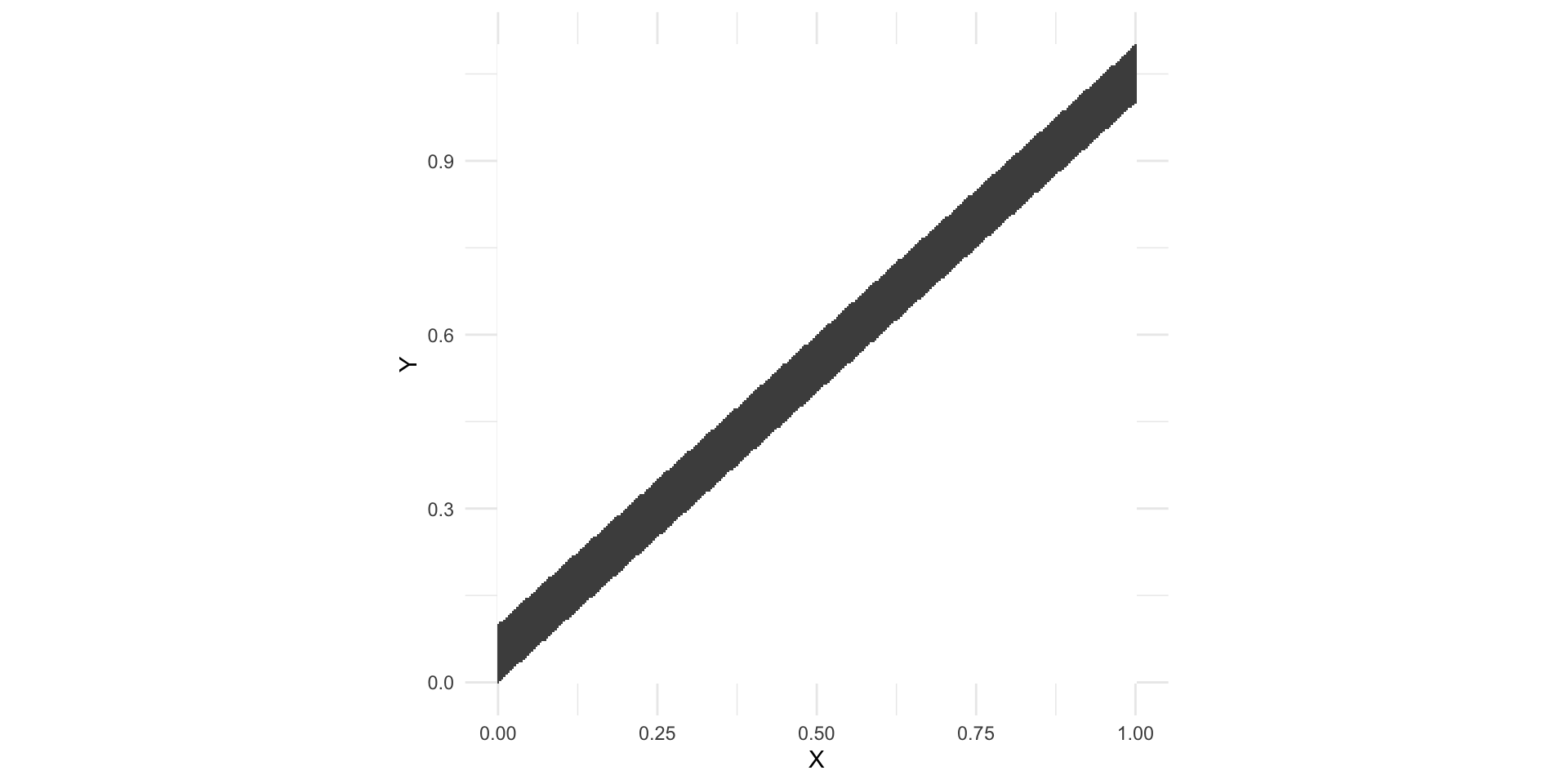
In gray: the region where f_{X,Y}(x,y)>0
- When X increases, Y increases linearly (not surprising, since Y = X + Z)
- We expect the correlation \rho_{XY} to be close to 1
Example 1 – Computing \rho_{XY}
For a random variable W \sim {\rm uniform} (a,b), we have {\rm I\kern-.3em E}[W] = \frac{a+b}{2} \,, \qquad {\rm Var}[W] = \frac{(b-a)^2}{12}
Since X \sim {\rm uniform} (0,1) and Z \sim {\rm uniform} (0,1/10), we have {\rm I\kern-.3em E}[X] = \frac12 \,, \qquad {\rm Var}[X] = \frac{1}{12} \,, \qquad {\rm I\kern-.3em E}[Z] = \frac{1}{20} \,, \qquad {\rm Var}[Z] = \frac{1}{1200}
Since X and Z are independent, we also have {\rm Var}[Y] = {\rm Var}[X + Z] = {\rm Var}[X] + {\rm Var}[Z] = \frac{1}{12} + \frac{1}{1200}
Example 1 – Computing \rho_{XY}
Since X and Z are independent, we have {\rm I\kern-.3em E}[XZ] = {\rm I\kern-.3em E}[X]{\rm I\kern-.3em E}[Z]
We conclude that \begin{align*} {\rm Cov}(X,Y) & = {\rm I\kern-.3em E}[XY] - {\rm I\kern-.3em E}[X] {\rm I\kern-.3em E}[Y] \\ & = {\rm I\kern-.3em E}[X(X + Z)] - {\rm I\kern-.3em E}[X] {\rm I\kern-.3em E}[X + Z] \\ & = {\rm I\kern-.3em E}[X^2] - {\rm I\kern-.3em E}[X]^2 + {\rm I\kern-.3em E}[XZ] - {\rm I\kern-.3em E}[X]{\rm I\kern-.3em E}[Z] \\ & = {\rm Var}[X] = \frac{1}{12} \end{align*}
Example 1 – Computing \rho_{XY}
The correlation between X and Y is \begin{align*} \rho_{XY} & = \frac{{\rm Cov}(X,Y)}{\sqrt{{\rm Var}[X]}\sqrt{{\rm Var}[Y]}} \\ & = \frac{\frac{1}{12}}{\sqrt{\frac{1}{12}} \sqrt{ \frac{1}{12} + \frac{1}{1200}} } = \sqrt{\frac{100}{101}} \end{align*}
As expected, we have very high correlation \rho_{XY} \approx 1
This confirms a very strong linear relationship between X and Y
Example 2
Assume X and Z are independent, and X \sim {\rm uniform} \left( -1,1 \right) \,, \qquad Z \sim {\rm uniform} \left( 0, \frac{1}{10} \right)
Define the random variable Y = X^2 + Z
Since X and Z are independent, and Z is uniform, we have that Y | X = x \, \sim \, {\rm uniform} \left( x^2, x^2 + \frac{1}{10} \right) (adding x^2 to Z simply shifts the uniform distribution of Z by x^2)
Question: Is the correlation \rho_{XY} between X and Y high or low?
Example 2
As Y | X \, \sim \, {\rm uniform} \left( X^2, X^2 + \frac{1}{10} \right), the conditional pdf of Y given X = x is f(y|x) = \begin{cases} 10 & \text{ if } \, y \in \left( x^2 , x^2 + \frac{1}{10} \right) \\ 0 & \text{ otherwise} \end{cases}
As X \sim {\rm uniform} (-1,1), its pdf is f_X(x) = \begin{cases} \frac12 & \text{ if } \, x \in \left( -1 , 1 \right) \\ 0 & \text{ otherwise} \end{cases}
Therefore, the joint distribution of (X,Y) is f_{X,Y}(x,y) = f(y|x)f_X(x) = \begin{cases} 10 & \text{ if } \, x \in (-1,1) \, \text{ and } \, y \in \left( x^2 , x^2 + \frac{1}{10} \right) \\ 0 & \text{ otherwise} \end{cases}
Example 2
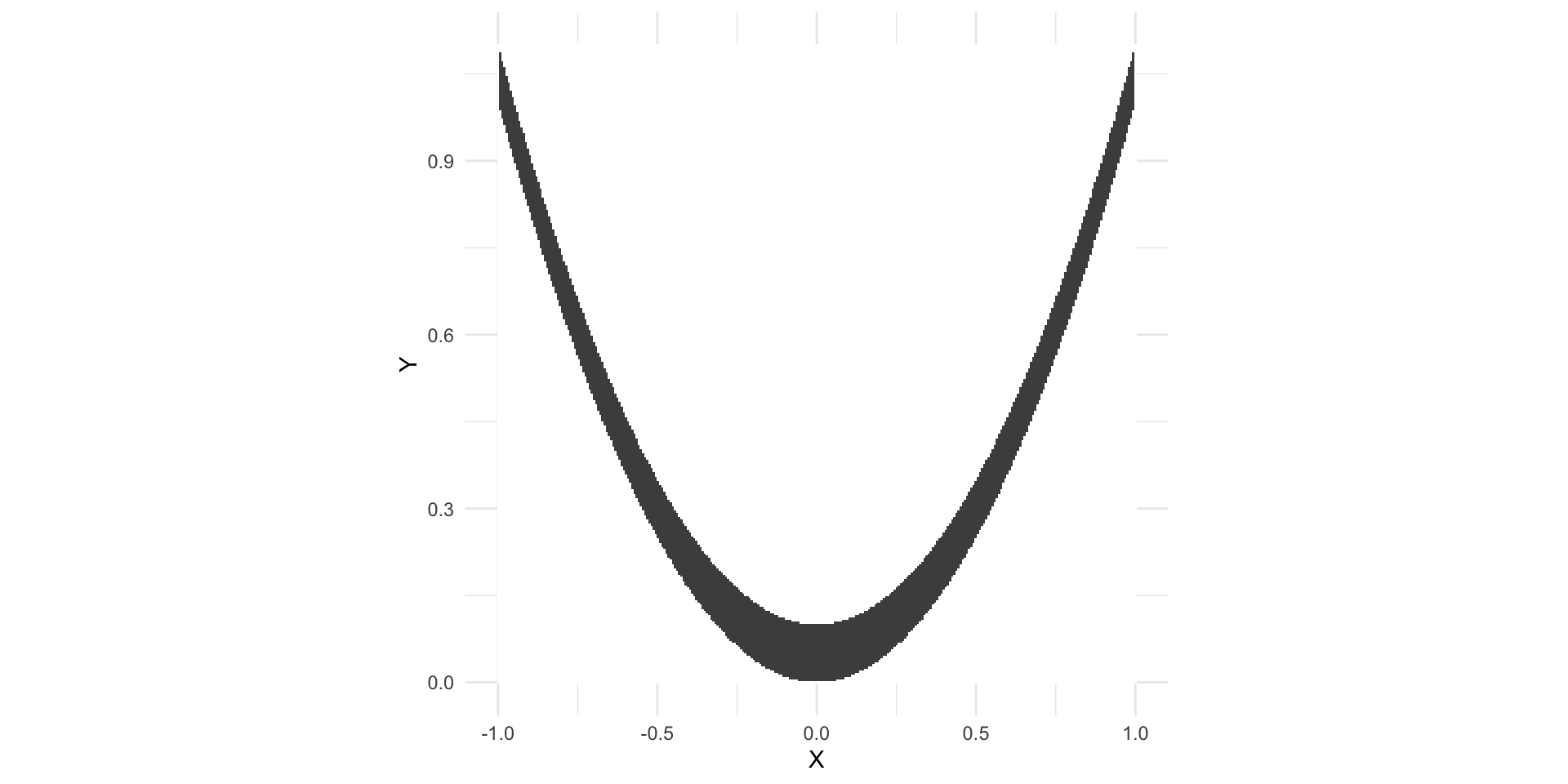
In gray: the region where f_{X,Y}(x,y)>0
- When X increases, Y increases quadratically (not surprising, as Y = X^2 + Z)
- There is no linear relationship between X and Y \,\, \implies \,\, we expect \, \rho_{XY} \approx 0
Example 2 – Computing \rho_{XY}
Since X \sim {\rm uniform} (-1,1), we can compute that {\rm I\kern-.3em E}[X] = {\rm I\kern-.3em E}[X^3] = 0
Since X and Z are independent, we have {\rm I\kern-.3em E}[XZ] = {\rm I\kern-.3em E}[X]{\rm I\kern-.3em E}[Z] = 0
Example 2 – Computing \rho_{XY}
Compute the covariance \begin{align*} {\rm Cov}(X,Y) & = {\rm I\kern-.3em E}[XY] - {\rm I\kern-.3em E}[X] {\rm I\kern-.3em E}[Y] \\ & = {\rm I\kern-.3em E}[XY] \\ & = {\rm I\kern-.3em E}[X(X^2 + Z)] \\ & = {\rm I\kern-.3em E}[X^3] + {\rm I\kern-.3em E}[XZ] = 0 \end{align*}
The correlation between X and Y is \rho_{XY} = \frac{{\rm Cov}(X,Y)}{\sqrt{{\rm Var}[X]}\sqrt{{\rm Var}[Y]}} = 0
This confirms there is no linear relationship between X and Y
References
[1]
Bingham, Nicholas H., Fry, John M., Regression, linear models in statistics, Springer, 2010.
[2]
Fry, John M., Burke, Matt, Quantitative methods in finance using R, Open University Press, 2022.
[3]
Casella, George, Berger, Roger L., Statistical inference, second edition, Brooks/Cole, 2002.
[4]
DeGroot, Morris H., Schervish, Mark J., Probability and statistics, Fourth Edition, Addison-Wesley, 2012.
[5]
Dalgaard, Peter, Introductory statistics with R, Second Edition, Springer, 2008.
[6]
Davies, Tilman M., The book of R, No Starch Press, 2016.